
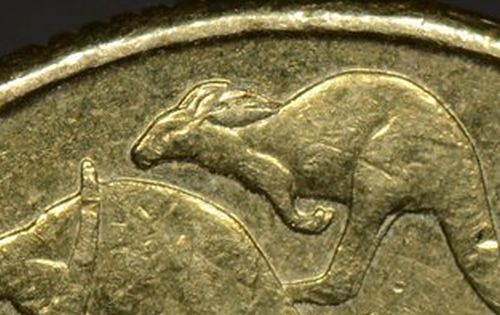
The "Rabbit Ear" Dollar
How a Tiny Die Chip Created an Aussie Icon
If you’ve ever spent time "noodling" through a jar of coins or a roll of one-dollar pieces, you know that the thrill is all in the details. While most people are looking for shiny new commemoratives, seasoned Australian collectors are often squinting at the ears of a very specific kangaroo.
Welcome to the story of the "Rabbit Ear" Dollar—perhaps the most famous "unintentional" icon in Australian numismatics.
What Exactly is a "Rabbit Ear" Dollar?
The standard Australian one-dollar coin features the "Mob of Five" kangaroos, a design by Stuart Devlin that has been in our pockets since 1984. On the "Rabbit Ear" variety, the top-most kangaroo appears to have a third ear—or a very long, upright rabbit ear—sticking out from the back of its head.
But this wasn't a secret design choice by the Mint. It is what collectors call a "Die Chip" error.
The Science of the "Chip"
Coins are made by striking a metal blank (a planchet) with a heavy steel stamp called a die. Over time, these steel dies undergo immense pressure and eventually begin to degrade.
- A tiny piece of the steel die breaks off (chips away).
- Because the die now has a small hole or "void" in it, the metal from the coin blank flows into that gap during the next strike.
- The result? A raised "blob" of metal on the coin’s surface that wasn't supposed to be there.
In the case of the Rabbit Ear, the chip happened exactly at the top of the lead kangaroo's head, creating that distinctive, pointy extra appendage.
Why is it So Popular?
There are thousands of die-chip errors out there, so why did this one become a superstar?
- Visual Appeal: Unlike a random blob of metal on a field, this chip looks intentional. It transforms the animal into a "hybrid" creature that is easy to see with the naked eye.
- Specific Years: While die chips can happen anytime, the Rabbit Ear is most famously associated with the 1984, 1985, 1994, 1998, and 2000 $1 coins. The 1994 "Mob of Five" is particularly prized by collectors.
- The Gateway Error: Because it’s relatively easy to find if you look closely enough, it’s often the first "variety" that new collectors discover, making it a sentimental favourite.
What is it Worth?
The value of a Rabbit Ear Dollar depends entirely on the year and the condition of the coin.
- Circulated Finds: A common year Rabbit Ear found in your change might fetch anywhere from $5 to $20 on platforms like eBay.
- High Grade: If you find a "Rabbit Ear" in Uncirculated (UNC) condition—meaning it looks like it just popped out of the Mint—the price can jump significantly, sometimes reaching $50 to $100+.
How to Spot One
Next time you have a handful of gold coins, follow these steps:
- Find the "Mob of Five": Look for the standard $1 design (not a commemorative one).
- Locate the Top Kangaroo: Focus on the largest roo at the top of the pile.
- Check the Head: Look at the space just behind its ears. If you see a distinct, raised vertical "ear" or "spike," congratulations—you’ve found a Rabbit Ear!
The Legacy of the Chip
The Rabbit Ear Dollar proves that in the world of coin collecting, "perfection" isn't always the goal. Sometimes, it’s the little mistakes—the mechanical hiccups of a busy Mint—that capture our imagination and turn an ordinary dollar into a piece of Aussie history.
Happy hunting!
Do you have a "Rabbit Ear" in your collection, or are you on the lookout for the even rarer "Speared Roo" or "Dropping Proo" varieties? Let us know in the comments!
Please login to post a comment.
We strive to provide a transparent marketplace built on expert grading, verified provenance, and uncompromising ethical standards. We aim to educate enthusiasts of all levels, providing the tools and data needed to build meaningful and valuable collections.
Useful Links
Information
Join our newsletter
We write rarely, but only the best content.
We'll never share your details. See our Privacy Policy
